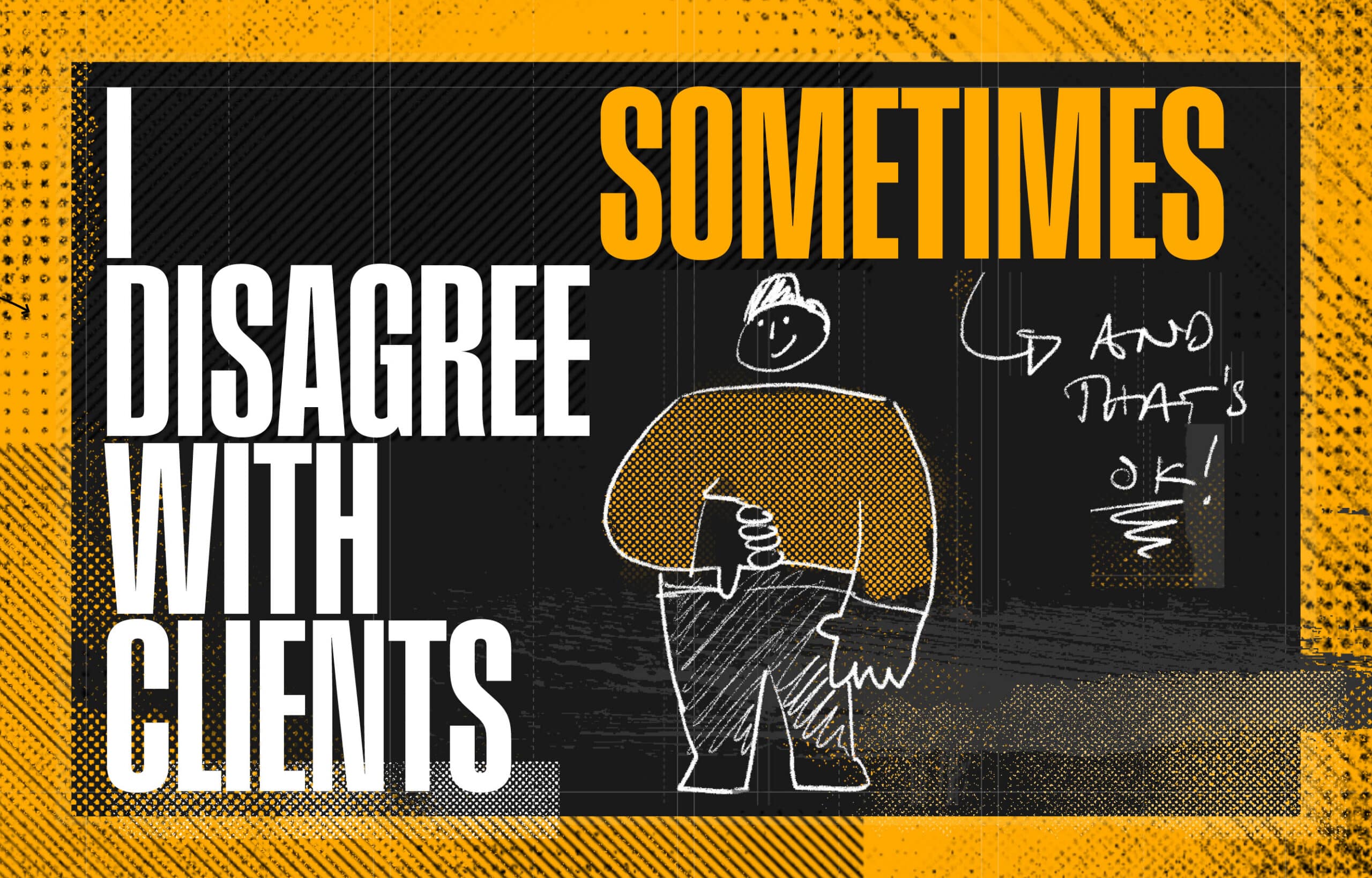
I disagree with clients sometimes.
Not all the time. Not about small things, and not loudly. But genuinely, on things that matter.
I didn’t always. Earlier in my career I found ways to make almost anything work. I was good at reframing. Good at finding the version of a client’s idea that could be executed professionally. Good at the kind of accommodation that keeps everyone comfortable.
The work that produced was fine. Competent. Sometimes genuinely good.
But I look back at the projects from that period and I notice something. The ones I’m proudest of — the ones that feel like they produced something with real value — are almost all from moments where I stopped accommodating and started saying what I actually thought.
Why designers don’t say it
There are real reasons most designers don’t push back plainly.
The client is paying. There’s a power dynamic in that, even in professional service relationships where expertise is supposed to carry weight. The designer is a supplier. The founder is the client. Disagreeing with a client doesn’t feel professionally comfortable.
There’s also a reasonable desire to preserve the relationship. Brand projects require trust to produce good work. Challenging someone’s direction can feel like it risks the trust that makes the work possible.
And there’s a more uncomfortable reason: uncertainty. It’s genuinely hard to know when your disagreement is right. When you’re pushing back because you can see something the client can’t, and when you’re pushing back because your aesthetic preference is different from theirs. That distinction matters, and it’s not always clear.
All of that is real. But I’ve come to believe that the accommodation it produces — the “yes and” approach, the diplomatic reframe, the version of the client’s idea that can be made to work — costs more than the alternative.
What the disagreement actually sounds like
It’s not a confrontation. It’s not a defence of artistic vision against commercial pragmatism.
It’s usually quite simple. “I understand why you want this, but I think it’s working against what we established in strategy. Here’s why.” Or: “I think this direction closes off something the brand needs to be able to do. Let me show you what I mean.”
It’s specific. It’s reasoned. It’s connected to the work we’ve done together, not to a preference.
And it’s honest. Not diplomatically softened into something that technically expresses a concern while making clear I’ll do whatever they want. Actually honest.
The founders who respond well to that — and most of them do — are the ones I do my best work with. Because they can engage with the reasoning. They can push back on the pushback. They can say “I hear that, but here’s why I think you’re wrong” — and that conversation, when it’s genuinely productive, usually produces something better than either position started at.
What happens to the relationship
Counterintuitively, honest disagreement usually strengthens the working relationship rather than straining it.
Because it signals something. That I’m not just executing a brief. That I’m genuinely invested in the outcome. That when I say something is right, the founder can trust that I mean it — because they’ve seen me say something else is wrong.
The designer who agrees with everything is comfortable to work with, but hard to trust. Because you can never be sure whether the approval is genuine or just professional. When I disagree and explain why, and the founder chooses to trust the reasoning — that’s when the relationship becomes something more than transactional.
That’s when we’re actually working together.
The projects I’m most proud of
There are three or four projects in my career that I think about when I think about doing this well.
What they have in common isn’t that I was right and the client was wrong. Sometimes I was, sometimes I wasn’t. What they have in common is that there was a moment of genuine disagreement that both sides engaged with honestly. The outcome was shaped by the tension, not by one side prevailing.
That tension — when it’s productive — is where the most interesting work happens. Not the smooth delivery of an expected outcome, but the harder process of finding something neither side could have arrived at alone.
For more on how brand strategy shapes the decisions that follow, pattendesign.co.uk/the-b2b-founders-guide-to-standing-out-in-a-crowded-market/ is worth reading if you’re in a B2B market and thinking about differentiation.