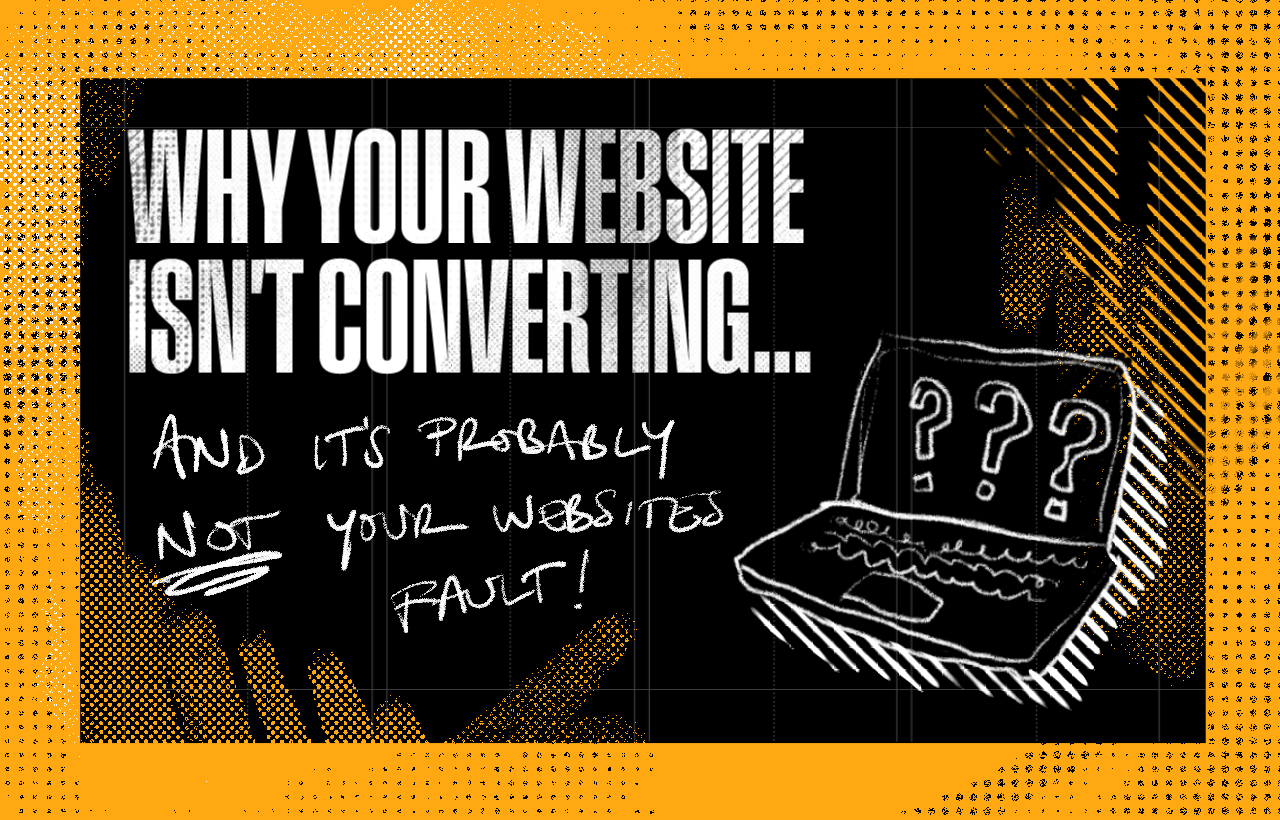
The conversation usually goes like this: the website isn’t working. Traffic is there but enquiries aren’t. People arrive and leave without getting in touch. Something is off and the working assumption is that the website is the problem — the design, the layout, the calls to action, the journey.
So the website gets redesigned. New pages, new structure, new photography, new colour scheme. Sometimes a new platform. Often a not-inconsiderable amount of money. And then, a few months later, the conversion numbers are not much different from before.
This is one of the most common and most avoidable mistakes in small business marketing. Because in the majority of cases I’ve seen, the website isn’t the problem at all.
The problem is what’s underneath it.
Websites don’t create clarity. They reveal the absence of it.
A website is a surface. It reflects whatever is behind it — the brand, the positioning, the messaging, the clarity (or lack of it) with which the business understands and communicates what it does and for whom.
When a business is clear about its positioning, its audience, and what makes it genuinely different, that clarity comes through on the website almost naturally. Visitors understand immediately what the business does, who it’s for, and why they should care. The path from landing page to enquiry is short, because there’s nothing confusing in the way.
When a business isn’t clear about those things — even if the people running it are smart, experienced, and doing excellent work — the website exposes the confusion. Visitors can’t quickly understand what they’re looking at. The value proposition is vague. The messaging is generic. The calls to action lack conviction because the offer itself hasn’t been framed crisply enough to make a clear call to action possible.
You can redesign the surface as many times as you like. If the problem is what’s underneath it, a new surface won’t fix it.
The three brand problems most commonly mistaken for website problems
Unclear positioning. When a business hasn’t made explicit decisions about who it’s for and who it’s not for, the website ends up trying to speak to everyone — which means it resonates with no one in particular. The copy hedges. The imagery is generic. The tone is cautious rather than confident. Visitors can’t quickly work out whether this business is right for them, so they leave.
The fix isn’t better copy. It’s a positioning decision, made explicitly, before anyone touches the website.
A weak or absent value proposition. The value proposition is the answer to the question every website visitor is silently asking: why this business rather than any of the others? If that answer isn’t clear within the first few seconds of landing on a page, most visitors won’t stay long enough to find it.
This isn’t a copywriting problem — or at least, it’s not only a copywriting problem. It’s a brand strategy problem. Before you can write a compelling value proposition, you have to have one. That means being specific about what you do differently, for whom, and why it matters to them. Many businesses haven’t done that work explicitly. They have a sense of it internally but haven’t articulated it clearly enough to put on a page.
Inconsistent messaging. When the message on the homepage is slightly different from the message on the services page, which is slightly different from what the case studies imply, visitors experience a kind of low-level friction that’s hard to name but easy to feel. The business doesn’t quite hang together. Something’s off, but they can’t say what.
This inconsistency is almost always a brand problem. The business hasn’t settled on a single clear message and applied it across all touchpoints. So different pages end up telling slightly different stories, and the cumulative effect is a brand that doesn’t quite trust itself.
What a website can and can’t do
A well-designed, well-built website can do a lot: it can present information clearly, create the right first impression, guide visitors towards an action, and support conversion when someone has already decided they’re interested.
What it can’t do is manufacture interest in a business that hasn’t given them a clear reason to be interested. It can’t resolve a positioning problem by presenting an unclear position more beautifully. It can’t make a weak value proposition compelling through better typography.
These things have to be resolved before the website is built — or rebuilt.
The brand-first argument for digital
This is why I describe my approach as brand-first. Not because the website doesn’t matter — it absolutely does — but because the brand is the foundation the website is built on. Get the foundation wrong and you’ll be rebuilding again sooner than you expect.
The right sequence is: strategy first (who are we, who are we for, what do we stand for, what are we claiming?), then messaging (how do we say that in a way that resonates?), then identity (how does that look and feel?), then website (how do all of that play out across digital?).
Every step in that sequence informs the next. A website built without going through the earlier steps is a website built in a strategic vacuum. It might look good. It probably won’t convert the way it should.
A question worth asking
Before commissioning another website redesign, it’s worth spending a few minutes answering these questions honestly: can you articulate in one sentence what makes your business different from its closest competitors? Do you know exactly which type of client you most want to attract, and why? Is your messaging consistent across your website, your proposals, your LinkedIn presence, and your marketing?
If those questions are harder to answer than they should be, the website is not where to start.
I design websites — but only after the brand foundation is right. That sequence produces websites that actually do the job they’re built for.
I’m based in Surrey and work with businesses across the UK, including London and South London, on this kind of work — the strategy, the identity, and the digital expression that follows from both.