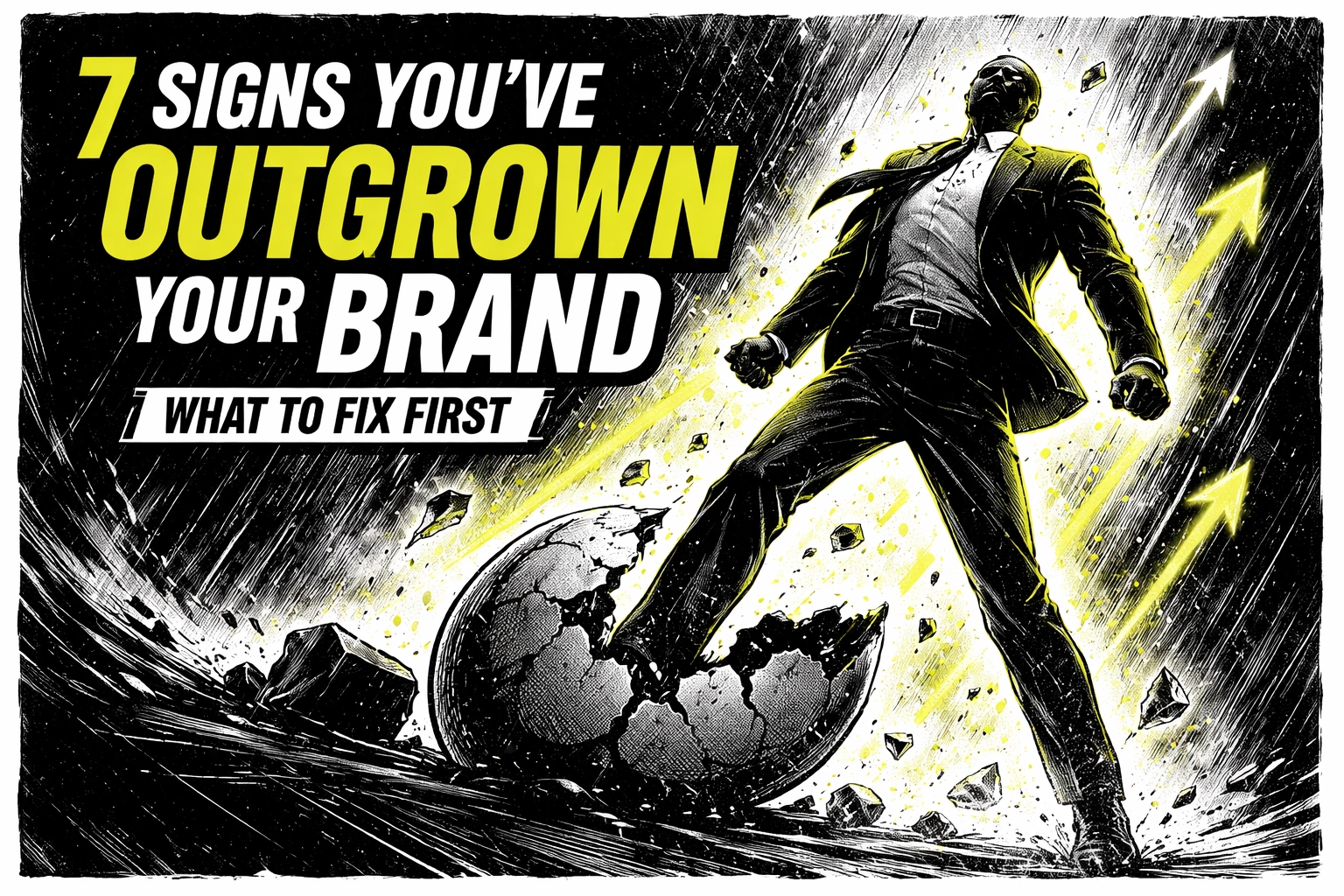
Your brand got you here. But it won’t get you there.
That scrappy logo you made at 2am. The colour palette you picked because it “felt right.” The tagline that made sense when you were three people in a co-working space.
It worked. Until it didn’t.
Growth exposes cracks. What once felt authentic now feels amateur. What once felt flexible now feels inconsistent. Your brand hasn’t evolved with your business, and your audience can tell.
Here’s how to know when it’s time for a change. And what to tackle first.
Sign 1: Your Visual Identity Looks Like a Time Capsule
Open your website. Now open a competitor’s. Feel that slight cringe? That’s the first sign.
Trends in design move fast. What looked cutting-edge in 2021 now screams “we haven’t updated anything in years.” Gradients that aged poorly. Stock photography that feels generic. Typography that belongs in a different era.
Your brand’s visual identity is often the first thing prospects encounter. If it feels dated, they assume your product or service is too.
Fix first: Start with your logo and primary brand colours. These anchor everything else. A refresh doesn’t always mean a complete overhaul, sometimes it’s refinement. Sharper lines. Better contrast. A palette that feels current without chasing trends.

Sign 2: You Can’t Explain What You Do in One Sentence
Early-stage startups pivot. They experiment. They add services, drop products, chase opportunities.
The problem? Your messaging never caught up.
You’ve got three different elevator pitches floating around. Your homepage says one thing. Your LinkedIn says another. Your sales deck introduces concepts that don’t exist anywhere else on your site.
Confused prospects don’t convert. Period.
Fix first: Nail your positioning statement. One sentence. Who you help. What you do. Why it matters. Everything else, your tagline, your website copy, your social bios, flows from this.
Sign 3: Your Team Uses “Creative Interpretation” for Brand Assets
Ask five team members to create a presentation. You’ll get five different fonts. Four different logo variations. At least two colours that aren’t in your palette.
This isn’t their fault. It’s a systems problem.
Without clear brand guidelines, people improvise. They make decisions based on personal taste or whatever asset they find first. The result? A brand that looks fragmented. Unprofessional. Like multiple companies stitched together.
Research shows consistent branding across channels can increase revenue by up to 23%. Inconsistency costs you.
Fix first: Create, or update, your brand guidelines. Not a 50-page document no one reads. A practical, accessible resource with clear rules for logo usage, colours, typography, and tone of voice. Make it impossible to get wrong.

Sign 4: Your Brand Attracts the Wrong Clients
You’re getting enquiries. But they’re budget shoppers when you’ve moved upmarket. Or enterprise prospects when you serve SMEs. Or people who want services you stopped offering two years ago.
Your brand is a filter. It should attract your ideal clients and repel the wrong ones. When it stops doing that, every conversation becomes harder. More qualification. More education. More wasted time.
Fix first: Audit your customer personas against your current brand messaging. Are you still speaking to who you were targeting three years ago? Your ideal customer has likely evolved. Your brand language needs to evolve with them.
Sign 5: You’re Embarrassed to Send People to Your Website
The ultimate litmus test.
Someone asks for your website. You give them the URL but immediately start making excuses. “We’re actually working on a redesign.” “It doesn’t really reflect what we do now.” “The new site launches next month.” (It’s been “next month” for eight months.)
Your website is your digital storefront. In 2026, it’s often the only storefront. If you’re apologising for it, you already know it’s a problem.
59% of consumers prefer to buy from brands they recognise. A dated or confusing website kills recognition before it starts.
Fix first: Prioritise your homepage and key conversion pages. You don’t need to rebuild everything at once. But your homepage, services page, and contact page need to accurately represent who you are today. Not who you were when you launched.

Sign 6: Your Competitors Look More Established Than You
You know your product is better. Your service is superior. Your team is more experienced.
But side-by-side, their brand looks like a market leader. Yours looks like a startup still finding its feet.
Perception shapes reality. Prospects make split-second judgements based on visual credibility. A polished competitor with an inferior offering will often win against a scrappy brand with a superior one.
This isn’t about being flashy. It’s about signalling professionalism. Stability. Trustworthiness.
Fix first: Conduct a competitive audit. Screenshot competitor websites, social profiles, and marketing materials. Place yours alongside. Where do you fall short visually? Where does your messaging feel weaker? Target those gaps specifically.
Sign 7: Your Brand Doesn’t Reflect Your Ambition
This is the big one.
You’ve grown. You’ve hired. You’ve expanded your offering. Maybe you’ve raised funding or hit revenue milestones that seemed impossible when you started.
But your brand still looks like a side project.
There’s a mismatch between where your business is and where your brand lives. You’re playing in a bigger arena with startup-era equipment. It’s holding you back, from partnerships, from talent acquisition, from the clients you really want.
Fix first: Define your brand’s North Star. Not just what you do today, but where you’re heading. Your brand should be built for the company you’re becoming, not the company you were. This isn’t about faking scale. It’s about authentic evolution.
Where to Start When Everything Needs Work
Overwhelmed? Normal.
Most founders who’ve outgrown their brand see problems everywhere. The logo. The website. The messaging. The inconsistency. It feels like everything needs fixing immediately.
It doesn’t. Strategic sequencing matters.
Start here:
-
Positioning and messaging. Get crystal clear on who you are and who you serve. Everything else builds on this foundation.
-
Core visual identity. Logo, colours, typography. The building blocks that inform every other asset.
-
Brand guidelines. Document the rules so your team can execute consistently.
-
Website refresh. Apply your updated brand to your most important digital asset.
-
Collateral and touchpoints. Presentations, social profiles, email signatures. The details that compound into perception.
This isn’t a weekend project. But it’s also not the multi-year odyssey some agencies make it.
The Cost of Waiting
Every month you operate with an outgrown brand, you’re leaving opportunity on the table.
Prospects who bounced because your site felt dated. Partnerships that didn’t materialise because you looked too small. Talent who chose a competitor with a more compelling brand story.
These are invisible losses. You’ll never know the deals that didn’t happen. The conversations that never started.
Rebranding isn’t vanity. It’s strategy. It’s alignment between who you are and how you’re perceived.
Your brand got you here. But if you want to get there, wherever “there” is: it needs to evolve.