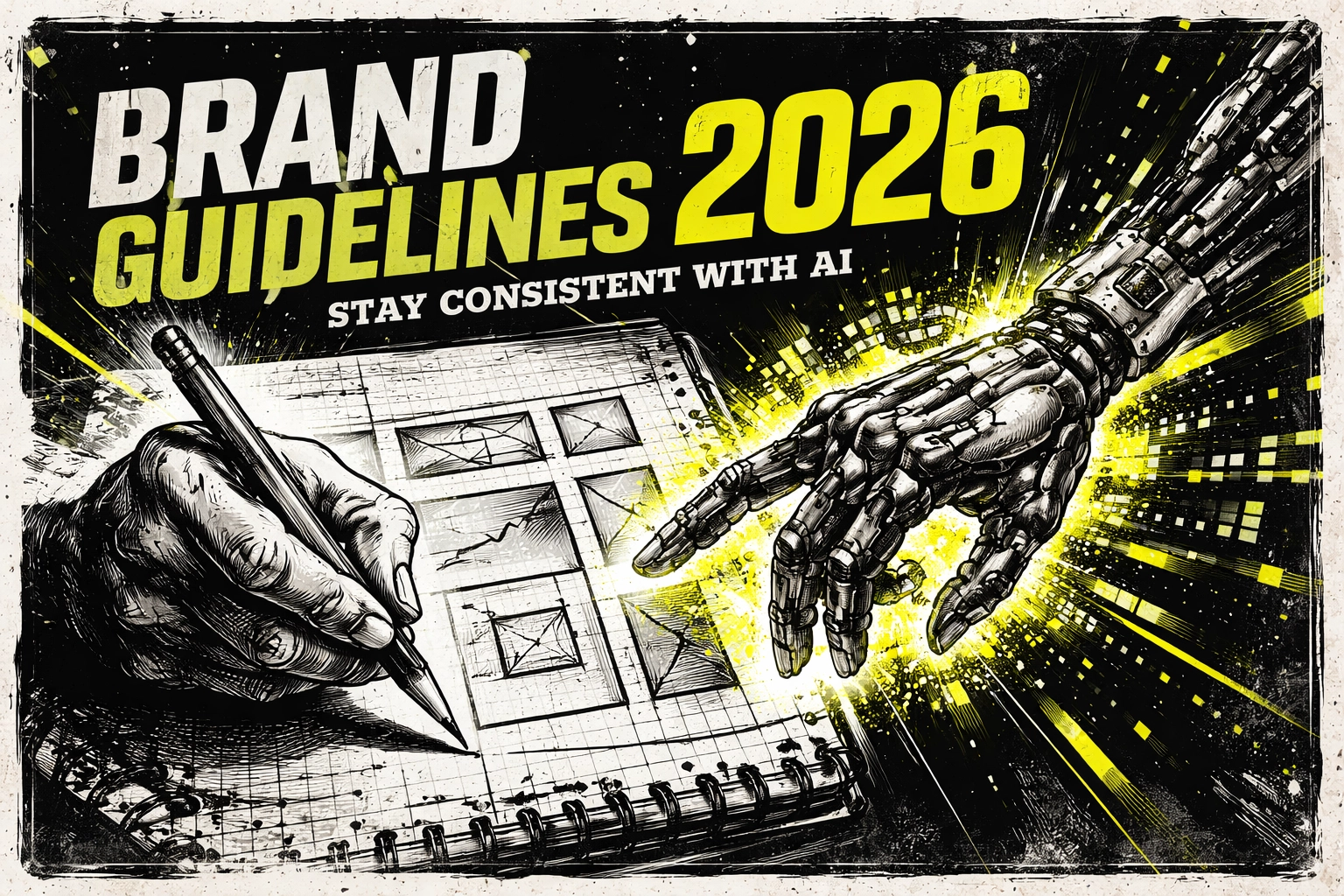
Your marketing assistant just used ChatGPT to write a LinkedIn post. Your designer fed Midjourney a prompt for a campaign visual. Your intern generated an email sequence with Claude.
Three different people. Three different AI tools. Three different interpretations of your brand.
This is 2026. AI isn’t coming for your brand: it’s already here. The question isn’t whether your team will use these tools. They already are. The real question: how do you keep your brand from fragmenting into a thousand AI-generated pieces?
The Consistency Crisis
Here’s the uncomfortable truth. Most brand guidelines were written for humans. They assume a human brain will interpret “friendly but professional” the same way another human brain will.
AI doesn’t work like that.
Feed an AI tool vague instructions like “match our brand voice” and you’ll get… something. Maybe it’s close. Maybe it’s wildly off. Maybe it sounds like a corporate robot trying to be your cool uncle.

The old playbook: a PDF with your logo specs and a few paragraphs about “brand personality”: doesn’t cut it anymore. AI tools need explicit parameters. Detailed examples. Clear boundaries.
Your team needs the same.
Why Traditional Guidelines Fail in the AI Era
Traditional brand guidelines assume context. They assume the person reading them understands nuance, company culture, and unwritten rules.
AI has none of that context. Zero institutional memory. No sense of “we’d never say it that way.”
When your junior copywriter uses AI to draft social content, that AI tool only knows what it’s told in that moment. Your twenty-page brand book sitting in a Google Drive folder? Invisible.
The result: brand drift. Slow at first. Then accelerating. Until one day you look at your content ecosystem and wonder who this company even is anymore.
Building AI-Ready Brand Guidelines
Time to upgrade. Your guidelines need to speak two languages now: human and machine.
1. Get Specific About Voice
“Friendly and professional” means nothing to an AI. Neither does “approachable yet authoritative.”
Instead, document the specifics:
- Sentence length preferences (short and punchy vs. flowing and detailed)
- Words you always use
- Words you never use
- Specific phrases that define your brand
- Punctuation habits (Oxford comma? Exclamation points?)
- How you address your audience (you/your vs. we/our)
Create a voice spectrum. Show where you sit between formal and casual, technical and simple, serious and playful. Give examples for each end.

2. Build a Prompt Library
Your team will prompt AI tools. That’s happening whether you plan for it or not.
So plan for it.
Create a library of approved prompts for common content types:
- Social media posts
- Email subject lines
- Blog introductions
- Product descriptions
- Customer responses
Include your brand context directly in these prompts. Voice guidelines. Tone markers. Example outputs that hit the mark.
This isn’t about controlling creativity. It’s about establishing a baseline. A starting point that’s already on-brand.
3. Document Visual Standards Like Never Before
AI image generators are everywhere now. Your team is using them. Are they using them correctly?
Your visual guidelines need to go deeper:
- Exact hex codes, RGB values, and CMYK codes for every brand colour
- Specific typefaces with fallback options
- Image style parameters (contrast levels, texture preferences, colour treatment)
- Composition rules with visual examples
- Clear “do” and “don’t” examples for AI-generated imagery

Think about creating actual prompt templates for image generation. Include style references, mood descriptions, and technical specifications that produce consistent results.
4. Create a Living Reference System
That PDF buried in your shared drive? Useless.
Your guidelines need to live where your team works. Cloud-based. Real-time. Always current.
Consider:
- A dedicated brand portal accessible to everyone
- Integration with the tools your team actually uses
- Version control so everyone’s working from the same page
- Quick-reference cards for common scenarios
When someone’s about to prompt an AI tool, your guidelines should be one click away. Not three folders deep in last year’s archive.
5. Establish Your North Star
Every piece of content: human or AI-generated: should ladder up to something bigger. Your brand’s core purpose. The emotional response you want to create.

Document this clearly. Not as corporate fluff but as practical guidance. When someone’s reviewing AI output, they should be able to ask: “Does this align with who we are?” and know the answer.
This becomes especially critical when AI generates something technically correct but emotionally wrong. Your north star helps your team catch those moments.
The Human Layer
Here’s what doesn’t change: humans still need to be in the loop.
AI generates. Humans curate.
Every piece of AI-assisted content needs human review. Not just for accuracy: for brand fit. Does this sound like us? Does this feel right? Would we actually say this?
Train your team on this review process. Help them understand not just what’s in the guidelines but why. Context helps humans make judgment calls that AI simply can’t.

Implementation: Where to Start
Feeling overwhelmed? Start small.
Week one: Audit your current AI usage. Who’s using what tools? For what content types? Where are the consistency gaps?
Week two: Identify your biggest risk areas. Social content? Sales emails? Visual assets? Focus your first efforts where inconsistency hurts most.
Week three: Create your first prompt templates. Pick three common content types. Build detailed prompts that include voice, tone, and style parameters.
Week four: Test and refine. Run the prompts. Review the outputs. Adjust. Repeat.
This isn’t a one-time project. It’s an ongoing process. AI tools evolve. Your brand evolves. Your guidelines need to keep pace.
The Competitive Advantage
Brands that figure this out win.
While competitors pump out generic AI-generated content that sounds like everyone else, you’ll maintain a distinctive voice. Recognisable. Consistent. Unmistakably yours.
That recognition builds trust. Trust builds loyalty. Loyalty builds business.
The companies treating AI as a wild west: letting every team member prompt their own way: will pay the price in brand dilution. You don’t have to be one of them.
Your Brand, Amplified
AI isn’t the enemy of brand consistency. Chaos is.
With the right guidelines, the right systems, and the right human oversight, AI becomes an amplifier. More content. Faster output. Same unmistakable brand.
That’s the goal. Not to fight the AI revolution but to harness it. To build something that scales without losing its soul.
Your brand guidelines are the key. Time to make them AI-ready.