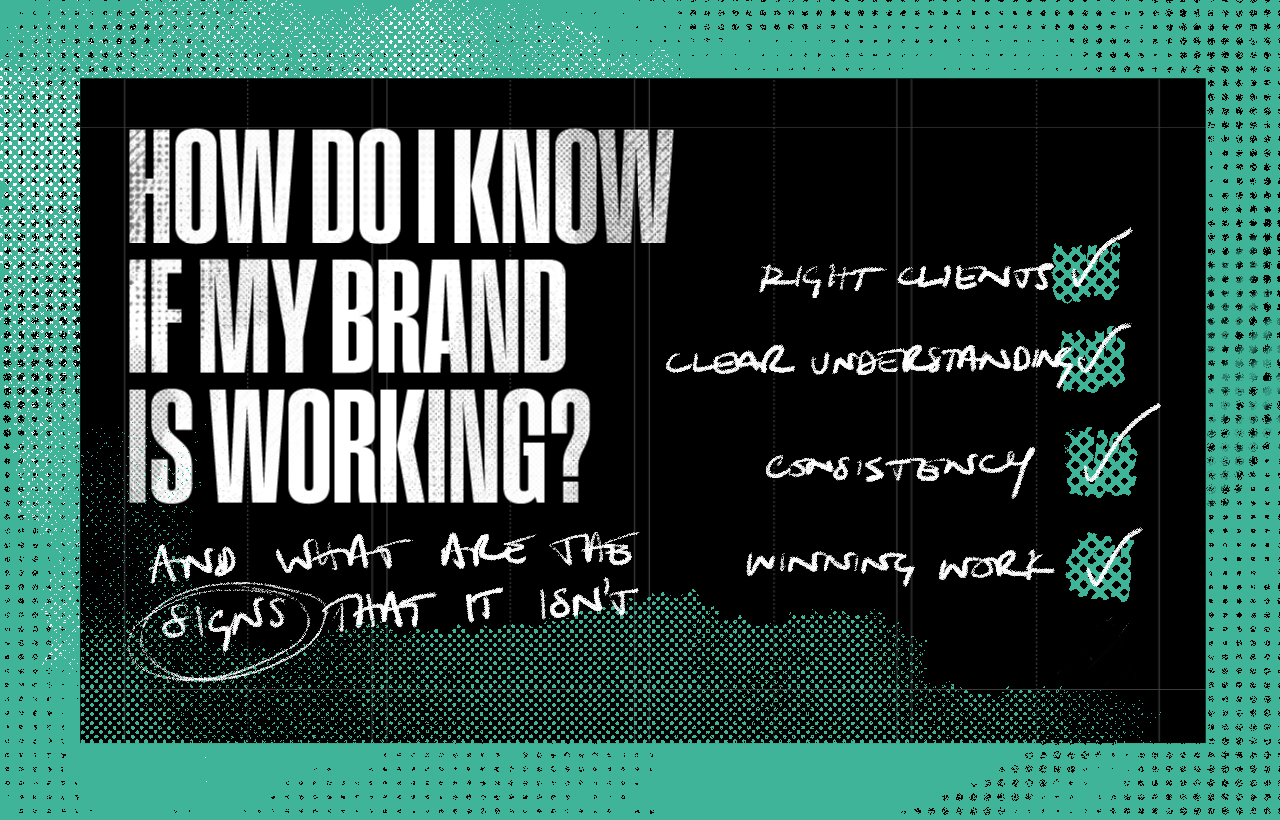
It’s a question that doesn’t get asked often enough. Most businesses invest in a brand, launch it, and then move on — measuring everything around it (website traffic, leads, revenue) while rarely stopping to assess whether the brand itself is doing its job.
Here are the criteria I’d use. None of them require a research budget or a specialist tool. They require honest answers.
Are you attracting the right clients?
Not clients in general — the right ones. The ones whose briefs fit what you actually do best. The ones where the engagement starts well and tends to go well. The ones at the level you want to be working at.
A brand that’s working is self-selecting for the right fit. It communicates clearly enough about who you are, what you do, and who you’re for that the people who land in your inbox are largely the people you’d want there.
If you’re consistently getting enquiries from businesses that are too small, too price-sensitive, or simply the wrong type of work — that’s information. The brand is attracting the wrong people, which means it’s signalling something other than what you intend.
Do people understand what you do immediately?
Send someone who doesn’t know your business to your website. Watch them use it, or ask them afterwards: what does this business do? Who is it for? Why would someone choose it over the alternatives?
If the answers are clear and accurate, the brand is working.
If there’s hesitation, or a vague description that misses what makes you different, or confusion about whether you’re for businesses like theirs — the brand is not communicating what you think it is.
This is worth doing more often than feels comfortable. You’re too close to your own brand to see it clearly. An outside perspective, even an informal one, tells you things that looking at your own materials never will.
Is your brand consistent across touchpoints?
The website, the proposals, the LinkedIn presence, the email signature, the business card, the way you’re introduced at an event — do these all feel like they’re coming from the same business?
Consistency isn’t uniformity. The register of a LinkedIn post is different from the register of a contract. But the underlying personality, the values, the tone — these should be recognisably the same. If they’re not, you have a consistency problem that’s eroding trust without you necessarily knowing it.
The test is to lay out everything side by side: website homepage, a recent proposal, a recent social post, a printed piece. Does it cohere? Does it feel like one business with a clear identity, or a collection of things made by different people at different moments?
Are you winning work at the level you want to be?
This is the commercial question. Brand isn’t just aesthetics — it’s positioning. And positioning determines what level of work you’re in the conversation for.
If you consistently find yourself in pitches you feel you should win but don’t, and you suspect presentation is part of why — that’s a brand signal. If you’re pricing below where you think you should be because the brand doesn’t give you the confidence to price higher — that’s a brand signal. If you’re being compared to competitors who you know do inferior work, but who look more credible — that’s a brand signal.
None of these things are certainly caused by the brand. But they’re worth investigating, because the brand is often where the answer lives.
The quick diagnostic
If you want to check where your brand stands without a lengthy process, the free 3-Point Brand Health Score is a practical place to start. It takes a few minutes and gives you a clear view of the gaps.
I’m based in Surrey and work with businesses across the UK — Surrey, South London, London, and further afield. If any of the questions above have prompted a less comfortable answer than you’d like, it’s worth having a conversation about what the brand is and isn’t doing.