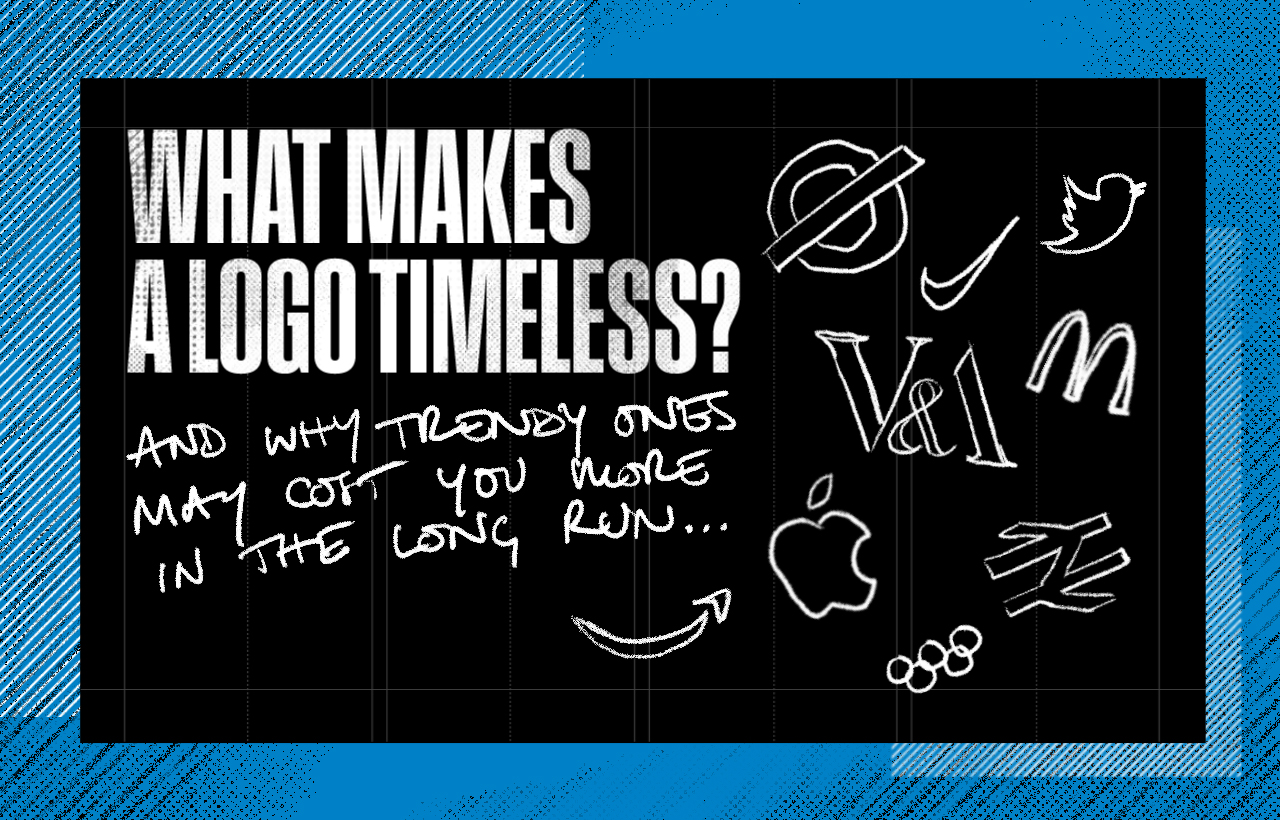
There’s a logo I think about often when this question comes up. It’s the London Underground roundel — a simple red circle and blue horizontal bar, with a wordmark through the centre. It was designed in 1916. It’s still in use today. It’s one of the most recognised marks in the world.
No gradients. No drop shadows. No bespoke illustration or intricate pattern work. Just a circle, a rectangle, and a typeface. And it communicates everything it needs to: place, clarity, belonging.
This is not an accident.
Timeless logos share a set of characteristics that have very little to do with what’s in fashion and everything to do with how they work. Understanding those characteristics is the difference between a logo that serves your business for ten years and one that looks dated in three.
The trap of the trend
Design, like any creative field, moves in cycles. Right now, certain things are everywhere: layered gradients, humanist serifs paired with geometric sans, hand-drawn elements, muted earthy palettes, wordmarks with mismatched character weights. In five years, these will date a brand as clearly as skeuomorphic shadows or lens flares date the design of the early 2000s.
That’s not a criticism of any of these things individually — some of them are executed beautifully. The problem is the motivation: designing from what’s current rather than what’s right for the specific business.
When a logo is built around a trend, it has a built-in expiry date. The trend moves on, the logo stays, and at some point the two diverge visibly. The business ends up looking like it belongs to a moment in time rather than to itself. And then comes the rebrand — which costs time, money, and the accumulated recognition the old logo had built up.
This is the real cost of trend-chasing: not just the money spent on the original work, but the cost of doing it again when the trend passes. And the erosion of consistency in the interval.
What actually makes a logo last
Distinctiveness over beauty. The most durable logos are not always the most beautiful. They’re the most ownable. They have something specific — a shape, a relationship, a quirk — that no one else has. The shell of Shell. The swoosh of Nike. The bitten apple. None of these would necessarily win a beauty contest. All of them are immediately, unmistakably themselves.
Distinctiveness can’t be borrowed. It has to be earned through specificity — a design decision rooted in something true and particular to the business, not something lifted from a mood board of current references.
Meaning over decoration. The best logos carry meaning without explaining it. The FedEx arrow hidden in the negative space between the E and the x. The Amazon smile that doubles as a range from A to Z. These are not design tricks for their own sake — they’re efficiency. A logo that rewards attention without demanding it is doing its job properly.
Decoration, on the other hand, adds visual noise without adding meaning. The elaborate pattern that looks impressive in isolation but falls apart at small size. The colour palette that was chosen because it felt nice rather than because it said something. These are the decisions that age quickly, because they were arbitrary to begin with.
Scalability as a design constraint. A logo that only works at large sizes is not a finished logo. It’s a proof of concept.
The environments a modern logo needs to navigate are genuinely demanding: a 16×16 pixel favicon, a billboard on the side of a building, a one-colour embossed finish on business stationery, a reversed-out version on a dark background, an animated version for digital. A logo that hasn’t been designed with all of these in mind will either fail in some of them or require constant workarounds.
Scalability forces simplicity. And simplicity, consistently, is where longevity lives.
Restraint as a creative decision. The hardest thing to do in logo design is not add — it’s take away. Every element that isn’t earning its place is a liability. It adds reproduction complexity, it competes for attention, it gives the design a ‘moment in time’ quality that precision and restraint avoid.
This is why great designers often arrive at simple solutions after a great deal of complex thinking. The simplicity at the end is not a lack of effort — it’s the evidence of it.
The Underground logo has nothing to do with its location
The reason the Underground roundel works isn’t geography. It’s the discipline behind it. The decision to use simple geometric forms. The commitment to a system that could be applied across an entire transport network without variation. The willingness to let the mark do one job, clearly, and not try to say everything at once.
Those principles apply to any logo, for any business, at any scale. They apply in Guildford and they apply in Bermondsey. They apply to a two-person consultancy and to a global platform. Good logo design is good logo design — it doesn’t change with postcode or headcount.
What I build for
When I design a logo, I’m not building for the trend cycle. I’m building for the business ten years from now — when the team has grown, when new markets have been entered, when the brand has accumulated recognition and trust that would be expensive to throw away.
That means making decisions that are harder to justify in the short term. Choosing restraint when the temptation is to embellish. Choosing distinctiveness over familiarity. Choosing scalability over visual drama at large size.
It also means being honest with clients when a direction is being led by what’s fashionable rather than what’s right. That’s not always a comfortable conversation. But it’s the one that produces logos that last.
I’m based in Surrey and work with founders and businesses across the UK — Surrey and South London, London, and further afield. If you’re at the point of commissioning a logo and you want it built to last, I’m happy to have that conversation.