We've got creativity all wrong.
Somewhere along the line, we started treating it like a rare gift. Something you either have or you don't. A mysterious quality reserved for artists, designers, and people who wear interesting glasses.
That's rubbish.
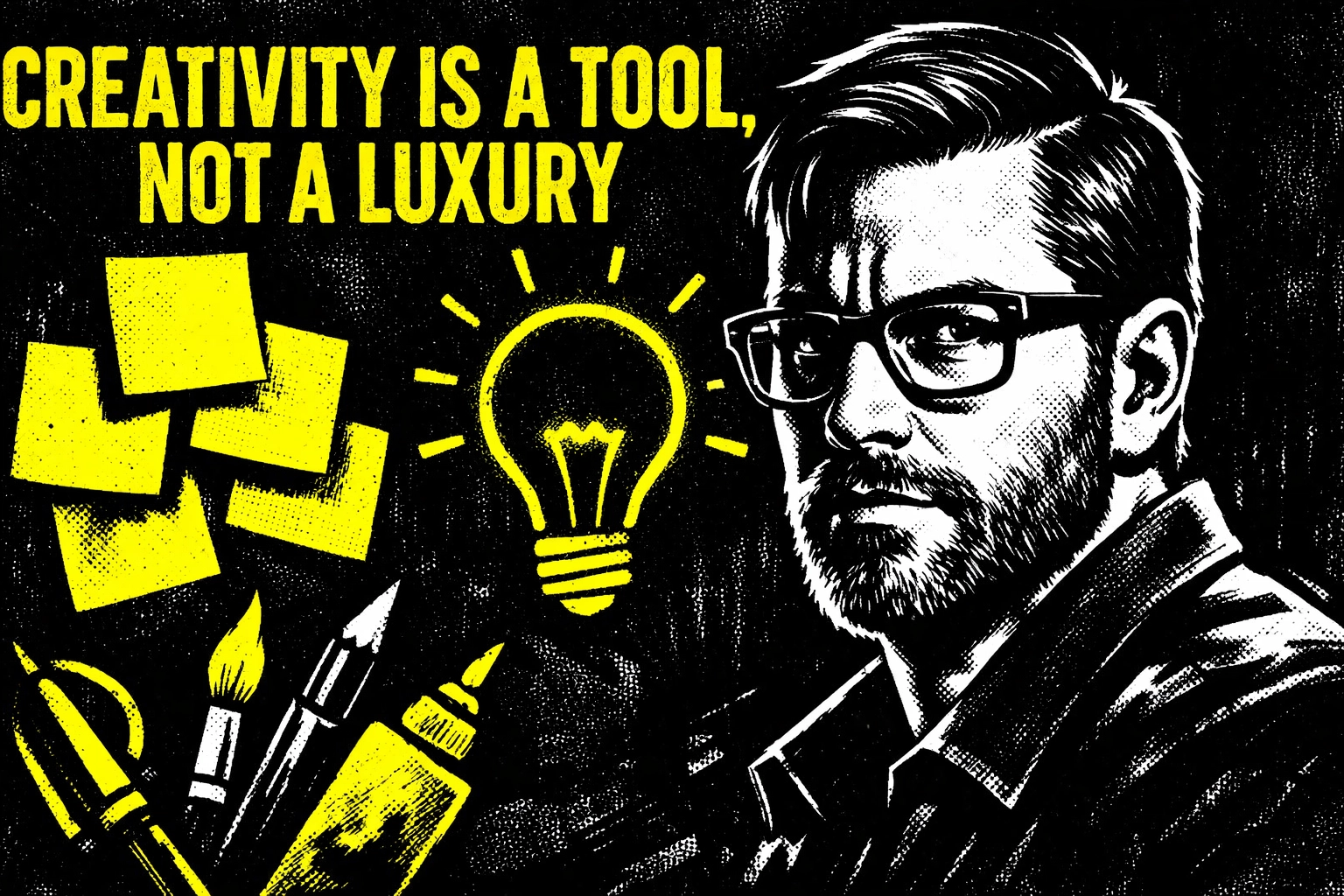
Creativity isn't a luxury item you pull out for special occasions. It's a practical tool that sits right next to strategy, analysis, and planning in your business toolkit. You wouldn't say "we can't afford leadership this quarter" or "analysis is nice, but we'll save it for when we have budget." So why do we treat creativity differently?
The talent myth
Here's the mix-up: we've confused creativity with talent and artistry. They're different things entirely.
Talent is a gift: some people can naturally carry a tune or have an eye for composition. Artistry is a craft: the years of practice that turn talent into skill. But creativity? That's neither. It's a learned capability, like teamwork or critical thinking.
You don't develop teamwork by reading about it. You play sports, work on group projects, mess up, figure it out. Creativity works the same way. You practice through story, design, music, movement, expression. You try things. Some work. Some don't. You get better.

Our ancestors figured this out 50,000 years ago. They weren't all "creative types." They just created. Cave walls, tools, stories. It was as natural as speaking or breathing. The impulse to make, solve, and express is biologically wired into us.
We've just convinced ourselves otherwise.
What creativity actually does
Strip away the mystique and creativity becomes remarkably practical.
It generates options when you're stuck. It finds connections between unrelated ideas. It reframes problems so solutions become obvious. It asks "what if" when everyone else is saying "that's how we've always done it."
In business terms, creativity drives:
Innovation. Not the buzzword version: the real kind where you actually build something new or improve something that exists.
Resilience. When markets shift or competition emerges, creative thinking adapts. It doesn't cling to what worked last year.
Culture. Teams that practice creative problem-solving together develop trust and psychological safety. They stop protecting their ideas and start building on each other's.
These aren't soft benefits. They're competitive advantages that show up in your bottom line, retention rates, and market position.

The business case
I've watched companies treat creativity as optional enrichment. Something for Friday afternoon workshops or team-building days. Then they wonder why their strategy feels stale or their brand doesn't resonate.
Creativity transforms organizations when you treat it as essential professional development. Not a nice-to-have. Not a bonus perk. A core competency.
Companies that build creative capacity consistently outperform competitors who don't. They spot opportunities earlier. They pivot faster. They build brands that mean something beyond features and pricing.
The research backs this up. Organizations that embed creative practice into their operations see measurable improvements in innovation output, employee engagement, and economic performance. It's not about becoming an "art company." It's about developing a strategic capability that makes everything else work better.
How it works in practice
Creative thinking follows patterns you can learn and apply.
Divergent thinking: Generate multiple possibilities without judgment. Push past your first three ideas: those are usually just variations on what already exists. The interesting stuff comes later.
Combinatory thinking: Connect concepts from different domains. What does retail strategy have in common with hospital workflows? More than you'd think.
Constraint-based problem solving: Limits force creativity. "Design anything" produces paralysis. "Design something that costs £50 and fits in a pocket" produces solutions.
Iterative refinement: Create, test, learn, adjust. Repeat. The first version is rarely the best version, but you can't get to version five without shipping version one.

You practice these approaches the same way you'd practice any skill. Regularly. With feedback. In contexts that matter.
The individual benefits
Beyond business outcomes, creative practice produces personal effects that improve how people work and live.
It induces flow states: that focused feeling where time disappears and work feels effortless. It reduces self-consciousness and anxiety. It builds confidence through small wins and tangible progress. It provides meaning when other areas feel uncertain.
These benefits appear whether someone produces "impressive" work or simply creates for personal expression. The value is in the practice, not the outcome.
During difficult periods: market downturns, organizational changes, global uncertainty: creative practice gives people agency. You can't control external circumstances, but you can make something new. That matters more than most leaders realize.
What this means for your brand
Your brand is a creative output. Every touchpoint, message, and visual element represents choices someone made.
When those choices come from people who practice creative thinking, the work improves. Not because they're "artistic," but because they've developed the ability to generate better options, spot stronger connections, and push past obvious answers.
This shows up in brand work as:
Differentiation that actually differentiates. Most brands look similar because most companies approach problems similarly. Creative thinking finds the angle everyone else missed.
Messaging that resonates. Generic copy comes from generic thinking. Strong messaging comes from understanding your audience deeply enough to say something that matters to them specifically.
Visual identity that works. Design isn't decoration: it's communication. Creative thinking ensures your visual choices support your strategy rather than just looking nice.

At Patten Design, we don't treat creativity as some mystical force. We treat it as a tool we've sharpened through practice. When you work with us, you're not hiring "creative people." You're hiring people who've built creative capability and know how to apply it to your specific challenge.
Making it practical
If you're ready to treat creativity as a tool rather than a luxury:
Practice regularly. Creative thinking atrophies without use. Build it into your workflow, not just special projects.
Create space for divergent thinking. Most meetings rush to solutions. Sometimes you need to explore options before choosing one.
Prototype cheaply. The faster you can test ideas, the more ideas you'll test. Low-fidelity prototypes beat perfect plans.
Mix disciplines. Creative breakthroughs often come from combining expertise from different fields. Get your finance person in the brand meeting.
Measure what matters. Track how creative practice affects outcomes you care about: customer response, employee retention, revenue growth.
The reality
Creativity isn't mysterious, magical, or reserved for special people. It's a learnable skill with practical applications and measurable benefits.
You already use it more than you realize. Every time you solve a problem, adapt to change, or communicate an idea, you're applying creative thinking.
The question isn't whether you can be creative. You already are. The question is whether you'll treat it as the strategic tool it is: or keep pretending it's a luxury you can't afford.